2.15.2012

Week of 6 Epiphany, Wednesday

The psalmist complains this morning about his accuser (109:17-18):

He put on cursing like a garment,*
      let it soak into his body like water
      and into his bones like oil;

Let it be to him like the cloak which he
           wraps around himself, *
      and like the belt that he wears continually.

I hope that in your practice of daily prayer (perhaps using the Daily Office), you will instead put on *Scripture* like a garment, that the living Word will soak into your body like water and into your bones like oil.

Perhaps over time you will find the weekly rhythms of the canticles and the seasonal themes of the collects wrapping around you like a new garment.

4.29.2011

The Royal Wedding


Prince William, Duke of Cambridge and Catherine, Duchess of Cambridge smile
following their marriage at Westminster Abbey. Photo: GETTY
As an Anglophile and liturgy geek, I naturally made a pot of tea and tuned in to the live coverage of the Royal Wedding this morning.

One of the glories of the Anglican tradition is its Book of Common Prayer -- the wedding service that William and Catherine participated in today is the same that every couple participates in. We all make the same vows "in the sight of God and in the face of this congregation."

The Bishop of London, Richard Chartres, made that same connection in his sermon. "In a sense every wedding is a royal wedding with the bride and the groom as king and queen of creation, making a new life together so that life can flow through them into the future."

"Faithful and committed relationships," he added, "offer a door into the mystery of spiritual life in which we discover this; the more we give of self, the richer we become in soul; the more we go beyond ourselves in love, the more we become our true selves and our spiritual beauty is more fully revealed. In marriage we are seeking to bring one another into fuller life."

The Bishop of London's Sermon at the Royal Wedding

God grant that Catherine and William, and every "royal couple" everywhere, will enjoy -- and share! -- the fruits of their faithfulness and commitment. That generous self-offering will indeed "set the world on fire."

3.23.2011

If You Have ....


I'm not sure of the original source of this image, but I heartily agree with its message.

See the General Thanksgiving in the service of Morning Prayer:

And, we pray, give us such an awareness of your mercies,
that with truly thankful hearts we may show forth your praise,
not only with our lips, but in our lives,
by giving up our selves to your service,
and by walking before you
in holiness and righteousness all our days. (BCP 101)

If you have ... then you are truly fortunate. If you have ... share.


2.06.2011

The Fifth Sunday after the Epiphany, or Super Bowl Sunday


"Let us also lay aside every weight
and the sin that clings so closely,
and let us run with perseverance
the race that is set before us" (Hebrews 12:1).

Not to make more of a morality play of the Super Bowl than the already over-hyped commentary has, but in today's spectacle we see the importance of the single-minded attention that the Letter to the Hebrews commends.

Aaron Rodgers has to lay aside the weight of expectation that has been on his shoulders since he replaced Brett Favre as the Packers' quarterback, the kind of weight that drags on you when you need to be quick, that causes you to second-guess yourself when you need to make snap decisions and follow through.

Ben Roethlisberger has to lay aside "the sin that clings so closely," letting the clamor of judgment about his past behavior (as justified as it may be) fade into the background so he can focus on the prize before him.

And so it is with us -- what burden are you carrying that you need to lay aside? What frustration, disappointment, guilt, or resentment do you need to let go of in order to be free to run?

What sin tangles you up every time you try to start a race? What habits, preoccupations, or judgments keep you from a relaxed and easy stride?

Now, for us the prize and focus of our attention is not the Lombardi Trophy (though at our Super Bowl parties this afternoon it will naturally consume our thoughts) but Jesus, "the pioneer and perfecter of our faith" (Heb. 12:2).

"Consider him who endured such hostility from sinners," the writer of Hebrews tells us, "so that you may not grow weary or lose heart" (Heb. 12:3).

Jesus is the one who stayed true to his calling and mission, "who for the sake of the joy that was set before him endured the cross, disregarding its shame, and has taken his seat at the right hand of God" (Heb. 12:2). As the pioneer and perfecter of our faith, his is the example we are to follow, his triumph is the goal we pursue, his endurance is the characteristic we emulate.

Though I may be wearing a jersey with the number 12 on it this afternoon and you (can it be true?) may wear one with a number 7, let's not forget that we are both running in the same race, the one in which we win by "outdoing one another in showing honor" (Romans 12:10).

And with God's help, we will not only win, but through our lives we will help others to turn their eyes toward Jesus and the victory he has already won for us.

2.03.2011

Ordination Anniversary

"He having promised to make Christ's redemptive love known ..."

Fifteen years ago today, Bishop Frank Griswold ordained me and six others to the diaconate at St. James Cathedral in Chicago.

Because Katrin and I had moved to Lake Geneva, Wisconsin six months earlier, I have never officially served as a deacon in the Diocese of Chicago -- all of my parish assignments have been in Wisconsin.

However, I worked in downtown Chicago until five years ago, so I was constantly "across the border" from the parishes I served. Now that my travels for work take me all over the country, I'm fortunate to be able to keep up with clergy colleagues and parishioners during the week through email, Facebook, and this blog.

But the Word become flesh is too intimate a truth to be preached from a distance, and I treasure every one of the people I have come to know in the five parishes I have served so far.

St. Paul's Episcopal Church, Milwaukee
Church of the Holy Communion, Lake Geneva
St. Luke's Episcopal Church, Whitewater
St. Luke's Episcopal Church, Racine
St. Thomas Episcopal Church, Menasha


Reading the Gospel at St. Thomas, Advent 2010
I also treasure the people I have known who are responding to God's call to serve as deacons and who have been my students in the Deacons' School over the years. Their enthusiasm and questions keep me connected to the roots of my own calling, to the baptismal ministry we all share in Christ.

The last 15 years have taken me to places I would not have imagined. Here's to what the next 15 will hold!

May the Lord by his grace uphold me -- and you! -- in the service he lays upon us. Amen.

1.17.2011

2 Epiphany, Monday

Daily Office Support Group

Four of us met this morning in the chapel at St. Thomas for Morning Prayer and a conversation about the practice of the Daily Office.

The structure of the Office is bewildering at first, so we started with bookmarks so that we could all find the Daily Office lectionary, the Collects, the psalms, the table of canticles, and all the other material that the Office requires.

As we prayed through a sort of "Instructed Morning Prayer," we talked a bit about the shape of the Office:

The Invitatory and Psalter

The Lessons

The Prayers

All the page-turning back and forth through the Book of Common Prayer can obscure that relatively simple pattern -- praying psalms, reading portions of Scripture and responding with canticles, and praying the three Collects that give the flavor of each specific day.

Handouts and discussion may have helped; we'll see what everyone's experience is as they try Morning Prayer on their own this week.

Here's to the three plucky members of the Daily Office Support Group who are diving in to this new practice!

1.16.2011

Second Sunday after the Epiphany


The Epistle appointed for this morning reminds us that in God's promises "we have this hope, a sure and steadfast anchor of the soul" (Heb. 6:19).

Please pray for the people of St. Thomas Episcopal Church in Menasha, WI -- my new parish -- as we begin to practice the Daily Office together in this Epiphany season.

Our "Daily Office Support Group" will say Morning Prayer together at the church on Mondays beginning tomorrow. Each week, we will also have some instruction in how to incorporate the Daily Office into our personal prayer lives.

As we sing God's praises, may we take to heart God's promises and build one another up in hope.

1.03.2011

2 Christmas, Monday

Not Quite Ordinary Time

Now that the frantic Christmas and New Year's holidays are past, many people are sighing with relief that things are "back to normal." As a neighbor said after we devoured the spread at yesterday's Packers/Bears football game, "Now I can go back to eating salads for dinner!"

But let's not settle down too much, too soon. According to the liturgical calendar, we're still in Christmastide -- yes, the Twelve Days begin, not end, with Christmas -- and it'll only be after the Feast of the Epiphany this Thursday that we enter into Ordinary Time.

The Church Year follows two cycles of feasts focused on celebrating the mysteries of Incarnation and Resurrection. In each cycle we have a season of preparation (Advent/Lent), the celebration itself (12 Days of Christmas/50 Days of Easter), and then a season of Ordinary Time in which we reflect on the meaning of the mystery (Epiphany/Pentecost).

The Old Testament reading appointed for Morning Prayer today gives us a foretaste of Ordinary Time. Jacob is traveling, as many of us do, and stops for the night in "a certain city" which could really be anywhere. That night he dreams of a ladder between earth and heaven, with angels ascending and descending upon it. When he wakes up, he says, "Surely the Lord is in this place -- and I did not know it!" (Gen. 28:16).

Ordinary Time is like that. We emerge from our celebration, look around our everyday lives with new eyes, and say, "Now I recognize that God is here!" Wherever our travels may take us, we see the presence of God in the normal places, the everyday experiences, the colleagues, family, and friends all around us.

So don't stop celebrating just yet -- this miracle of God with us, Emmanuel, is still worth pondering for a bit longer.

12.29.2010

Christmas in San Francisco

View from Point Reyes National Seashore
Katrin and I had the great pleasure of spending Christmas in San Francisco this year -- the first time either of us had been away from home and from the usual traditions.

One of the perks of my constant travel is that I can use frequent flyer miles and hotel points for our vacations, so we enjoyed stretching out in the first class cabin on the Delta flight to San Francisco and took in the view of the city from our room at the Hilton San Francisco Union Square.


On our first night in San Francisco, Anna arranged for us to go to Berkeley for dinner at Venus and to see "Arabian Nights" at the Berkeley Rep. What an absolutely enthralling play! With minimal staging -- only about $100,000 worth of Persian rugs and beautiful Arabic costumes -- the Rep created a completely captivating world and drew us in.

Photo of Berkeley Rep’s 2008 production courtesy of kevinberne.com
On Christmas Eve we did some Christmas shopping at Gump's, then went to Grace Cathedral for the Festival of Lessons and Carols, a sublime and moving service celebrating what the Dean of the Cathedral, Jane Shaw, calls "our outrageous but firm belief that God yearns to be part of our lives and world." In her welcome statement in the bulletin, Dean Shaw went on to say, "We believe that this really has happened in the person of Jesus Christ and continues to happen in us." Amen.


After the service, we strolled across Nob Hill to the Intercontinental Mark Hopkins Hotel for the Christmas Eve buffet dinner at the Top of the Mark. Suffice it to say we left no delicious morsel untasted!


On Christmas Day, we rode the cable cars to Chinatown and Fisherman's Wharf. Naturally, we chose to hang onto the open cable cars on the day when it poured down rain!


One of the seafood restaurants on the wharf, Cioppino's, was actually open on Christmas, so with Anna we enjoyed their namesake dish and a Dungeness crab pizza (most excellent!).


The next day, Anna planned an outing for us to Point Reyes National Seashore. In addition to the breathtaking views of the Pacific Ocean, we also literally lost our breath climbing the 303 steps down to the Point Reyes Lighthouse -- and back up again!


The girls were brave to try Drake's Bay oysters on our way from Point Reyes to Petaluma, and I got to practice my oyster shucking skills.


We also visited Larson Family Vineyards near Petaluma, enjoying a taste of their excellent wines (and bringing home four bottles to enjoy later!).
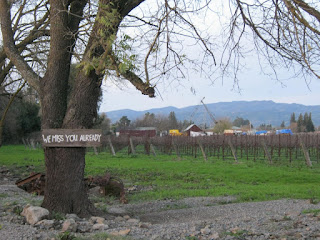
"We Miss You Already," says the sign as we leave Larson Family Vineyards.
On Tuesday, our last day in San Francisco, we met Anna for breakfast, then toured the Legion of Honor's newest exhibit, "Japanesque." It was not only a marvelous look at the making of familiar Japanese prints like Hokusai's Cresting Wave from his Thirty-Six Views of Mount Fuji, but the exhibit also traced the influence of that Japanese visual style on French artists of the Impressionist period. From Henri Riviere's Thirty-Six Views of the Eiffel Tower to Toulouse-Lautrec's posters, we saw what the French called "Japonisme" shaping their art.


Left: Hiroshige, Gion Shrine in the Snow (Gionsha setchu), from the series Famous Places in Kyoto (Kyoto meisho no uchi), ca. 1833–1834. Right: Henri Riviere, La Tour en construction, vue de Trocadero, pl. 3 from the book Les Trente-Six Vues de la Tour Eiffel, 1902. Color lithograph © 2010 ARS, New York / ADAGP, Paris


After a last look at the Golden Gate Bridge, we headed to the airport. The long flight to Minneapolis and the short hop to Appleton went smoothly, and we're now back at home reflecting on our blessings (and planning our next trip back to San Francisco!).

12.23.2010

4 Advent, Thursday

Daily visitation

My mother was pregnant with me at the time of my father's ordination, and she has often described how, when the bishop laid his hands on my father's head and pronounced his name, I gave a great kick inside her.

I thought of that story at my own ordination, where the Old Testament lesson was from Jeremiah. God tells him, "Before I formed you in the womb I knew you" (Jer. 1:5).

Reflecting on Jesus' birth to Mary -- the Incarnation that we celebrate starting tomorrow -- we learn that same lesson. Like Jesus, we are all known to God from before the beginning and throughout our lives. Like Jesus, we will also enter more fully into God's knowledge after our death. As Paul writes, "Now we see in a mirror, dimly, but then we will see face to face. Now I know only in part; then, I will know fully, even as I have been fully known" (1 Cor. 13:12).

In the collect for this fourth week of Advent we pray "purify our conscience, Almighty God, by your daily visitation" (BCP 212). Like Mary's visitation to her cousin Elizabeth, whose baby leaped for joy in her womb and who was filled with the Holy Spirit, our "visitation" with God in the Daily Offices offers a chance for the Spirit to speak to us and for new life to leap for joy inside us, too.

As we celebrate Christmas and dwell on the meaning of the Incarnation during the season of Epiphany, I invite you to practice "daily visitation" with God in the Daily Offices. What might the Holy Spirit have to say to you? What new life is in you, just waiting to leap for joy?

12.21.2010

St. Thomas the Apostle

Although you have not seen him, you love him

Today's edition of /slantwise/ is brought to you from beautiful Sausalito, California.

Because the hotel where I am staying is across from a marina, I have the words of the song "Brandy" running through my mind, especially the verse about the sailor.

He came on a summer's day
Bearing gifts from far away

But he made it clear he couldn't stay
No harbor was his home

After Jesus' resurrection, according to Christian tradition and legend, Thomas traveled far and wide, even as far as the Indian subcontinent, where the Mar Thoma Church bears his name. I wonder whether Thomas also felt that "no harbor was his home." Whether that's true or not, I do believe that he found a true anchor in the Lord Jesus Christ.

That confidence -- Thomas' unshakable conviction that Jesus is Lord and God -- led to his ministry of witness and evangelism. People coming after Thomas, even though they had never seen Jesus themselves, came to know him as their Lord, too.

We ourselves are the fruits of the witness given by Thomas and the men and women who were the first apostles of the resurrection. Their confidence, their unshakable conviction, has spread the message of Christianity across the world.

"Although you have not seen him, you love him," wrote Peter to his early congregation. "And even though you do not see him now, you believe in him and rejoice with an indescribable and glorious joy, for you are receiving the outcome of your faith, the salvation of your souls" (1 Peter 1:8-9).

I hope that you, too, in this season of hope, will find your confidence strengthened and your heart made joyful, for through the gifts we have received from Thomas and his companions we have come to know Jesus as our Lord and God.

12.18.2010

3 Advent, Saturday

Winter Ember Days


The rubric beneath the Collect for the Third Sunday of Advent doesn't give much away: "Wednesday, Friday, and Saturday of this week are the traditional winter Ember Days" (BCP 212). What are Ember Days, anyway?

According to the Calendar of the Church Year, the Ember Days are "traditionally observed after the First Sunday in Lent, the Day of Pentecost, Holy Cross Day, and December 13" (BCP 18).

Even church history doesn't shed much light on what the Ember Days are about. F.L. Cross notes in the Oxford Dictionary of the Christian Church that "their early history and original purpose are obscure" (Cross 455). Though they may have begun in the Roman Church as harvest, vintage and seed-time observances, in the Church of England they became associated with times for ordinations.

That's how they are observed in the Episcopal Church today, too. In many dioceses, the four "Ember Weeks" are times for postulants and candidates for holy orders to write to the bishop about their personal, spiritual, and academic formation. After their ordination, clergy may also be required to write the bishop once a year, perhaps during the Lenten Ember Days, to give the same kind of report.

Ordinations are often scheduled during Ember Days -- so it's no accident that in the Diocese of Fond du Lac, our bishop will ordain Jane Margaret Johnson to the diaconate today. I'd be willing to bet that her ordination to the priesthood will happen on or around June 18, during the Ember Days following Pentecost (and her graduation from seminary).

In the Daily Office, occasions like the Ember Days are good times to offer prayers to God not just for the clergy, but "for all members of your holy Church, that in their vocation and ministry they may truly and devoutly serve you" (BCP 100). All of us have a vocation or "calling" and all of us are responsible by virtue of our baptism to reach out in service to others.

The Ember Days, no matter what their origin, offer us an opportunity to hold one another up in prayer, that through our work and service, God's kingdom may come a little closer.

12.16.2010

3 Advent, Thursday

Hearts trained for greed

The lessons appointed for today offer a tight, sharp condemnation.

Both Peter and, before him, Isaiah call their communities to task for failing to live up to their high calling.

Peter warns the new church against false prophets, those whose message runs counter to Jesus' -- they have "hearts trained for greed" and "they will even deny the Master who bought them" (2 Peter 2:14c, 1b). In this, his message is very like Isaiah's.

Isaiah holds up a mirror to the greed of the people of Israel -- as a nation, they are devouring one another, making iniquitous decrees and unjust statutes, turning aside the needy from justice and robbing the poor of their right (Isa. 9:21--10:2).

The people who claim to follow God's will, in both cases, have forgotten that they were bought with a price, that they are to be in a special relationship with God, that their way is not to be the world's way.

And what of us today? We claim to follow Christ, but would that be apparent in the way we act? Are we in fact less greedy than those around us? Our lawmakers love to claim we are a Christian nation, but do our laws -- our decrees and statutes -- actually shelter the needy and give the poor their right? The words of condemnation are for our ears, too.

But our continual Advent hope is for the coming of God's Word:

"So is my word that goes forth from my mouth; *
     it will not return to me empty;
But it will accomplish that which I have purposed, *
     and prosper in that for which I sent it"
(The Second Song of Isaiah, BCP 87)

Now, as then, we need the sharp Word to lay open our hearts -- hearts trained for greed -- and to transform them into grateful hearts, tuned to sing God's praise and to listen to the cry of the poor.

"Offer to God a sacrifice of thanksgiving," the Psalmist says, "and make good your vows to the Most High" (Ps. 50:14).

12.07.2010

2 Advent, Tuesday

Pray without ceasing

I've been reading the books in Phyllis Tickle's The Divine Hours series -- a contemporary reworking of the Daily Offices into an accessible form -- and especially have enjoyed the introduction she gives to the practice of "fixed-hour prayer," her term for the Daily Office.

She notes that since the earliest days of the Christian church, and even before that in the practices of Jews living in Roman territories, it was the custom to mark the hours of the day with prayer.

As the Roman bells marked the first hour of the day, Prime at 6 am, punctuated the workday at Terce and Sext and None (9, noon, and 3) and closed the day at vespers (6 pm), Jews -- and the early Christians -- said brief prayers to mark the hours.

She also notes that "Christians today, wherever they practice the discipline of fixed-hour prayer, frequently find themselves filled with a conscious awareness that they are handing their worship, at its final "Amen," on to other Christians in the next time zone. Like relay runners passing a lighted torch, those who do the work of fixed-hour prayer do create thereby a continuous cascade of praise before the throne of God" (The Divine Hours 5).

I invite you to raise your voice in that unceasing prayer, whether it's in a formal way through the Daily Office or simply by being mindful as you pray of the "communion of saints" past and present and all around the world who join their voices with yours.

"Rejoice always, pray without ceasing, give thanks in all circumstances; for this is the will of God in Christ Jesus for you" (1 Thess 5:16-18).

12.06.2010

2 Advent, Monday

A nice little juxtaposition this morning.

I began to read Morning Prayer as my first flight of the day was preparing to take off, ignoring the flight attendants' safety demonstration, even though they regularly announce that even frequent fliers should pay attention.

When I got to the Collect of the Day, though, I stopped short. "Give us grace," we pray on the Second Sunday of Advent and throughout the week, "to heed their warnings and forsake our sins" (BCP 211).

Sometimes you need to close the book, open your eyes and ears, and pay attention.

I invite you to take a little time this week just to look and listen. Look for signs of God's steadfastness and encouragement around you. Listen for words of hope, whether they come over the plane's PA system or from some other unlikely source.

"And may the God of hope fill us with all joy and peace in believing, through the power of the Holy Spirit" (BCP 102).

12.03.2010

1 Advent, Friday

Do so more and more

As Paul wraps up his first letter to the church at Thessalonika, he urges them to continue demonstrating their love for one another and for the wider community of Christians.

"You do not need to have anyone write to you," he says, "for you yourselves have been taught by God to love one another; and indeed you do love all the brothers and sisters throughout Macedonia. But we urge you, beloved, to do so more and more" (1 Thess. 4:9-10).

In his commentary on 1 Thessalonians in The Illustrated Bible Handbook, Edward P. Blair notes that, "Christians are to go on becoming, by God's gracious help, what they already are in principle. One does not progress to holiness but in holiness, according to Paul" (Blair 312).

This growth in holiness is Paul's theme -- growth in the face of persecution, of misunderstanding, of idleness and other ethical dilemmas. Paul urges the Thessalonians to stay focused on love rather than controversy, "to aspire to live quietly, to mind your own affairs, and to work with your hands, as we directed you, so that you may behave properly toward outsiders and be dependent on no one" (1 Thess. 4:11-12).

Where in your life have you been distracted by controversy or gossip from the life of love and the growth in holiness that you are meant for? How is God calling you today to do more and more?

12.02.2010

1 Advent, Thursday

(One) Bride for Seven Brothers

Headmaster: Fetch hither the seven brides for seven brothers.
(Enter two schoolgirls.)
Padre: Right, do you four boys take these two girls to be your seven brides?
Boys: Yes, sir.
-From Monty Python's Flying Circus, 27 Oct 1970

So the Sadducees think they can trap Jesus with a trick question? You remember the story they spin, how the same poor woman keeps being remarried to brothers who keep dying off, and the Sadducees, "those who say there is no resurrection" (Luke 20:27), ask Jesus whose wife she will be in heaven.

But he turns it all around on them, telling them that in heaven they neither marry nor are given in marriage, "because they are like angels and are children of God, being children of the resurrection." Jesus goes on to say that God "is God not of the dead but of the living, for to him all of them are alive" (Luke 20:36-38).

The Sadducees' questions are too small; their scope too narrow. With a word, Jesus turns their gaze, and ours, from the mean concerns of life here on earth toward a glorious vision of life in the presence of God.

The question is, how should we act today, knowing we are meant for life with God? This is a question not about legality but about generosity, not about regulations but about welcome.

"You have spoken well," some of the scribes reply to Jesus (Luke 20:39-40), because they see they have no more questions big enough to ask him. Their eyes have been on the ground too long.

"You will save a lowly people," the Psalmist says in this evening's portion, "but you will humble the haughty eyes" (Psalm 18:28).

Padre: Right, go and do your prep.
(The curtain comes across quickly.)

12.01.2010

1 Advent, Wednesday

With my lips will I recite *
     all the judgments of your mouth.

One of the main benefits of "praying the Scriptures" the way that we do in the Daily Office is that the repetition of the antiphons and psalms and lessons and canticles and the Apostles' Creed and the collects gives us, over time, ready access to the language of God.

"The word is very near to you," we read in Deuteronomy. "It is in your mouth and in your heart for you to observe" (Deut. 30:14).

"How shall a young man cleanse his way?" the Psalmist asks in today's appointed portion. "By keeping to your words" (Psalm 119:9).

The Daily Office represents a time-tested way to "keep to God's words" by using them in prayer morning and evening, day after day, week after week, season after season. The offices themselves are essentially verses of Scripture arranged around a two-year cycle of readings from the Psalms and from the Bible -- the Psalms repeated every seven weeks, the bulk of the Old Testament read once every two years, and the New Testament twice.

One of the struggles people have when they desire to read more of the Bible is that they need to have some kind of plan -- just plunging in at Genesis often means people bog down in the "begats" when they hit the book of Numbers. The Daily Office lectionary offers one kind of plan, a scheme by which we use the Scriptures in prayer as a way of familiarizing ourselves with the language of God. It's not a study plan, but a prayer plan.

In fact, that's what our whole Book of Common Prayer is -- the prayer plan for leading a Christian life -- but that's a bigger subject for a different time.

For today, ask yourself if you would benefit from having some kind of plan to make sure the "word is very near you ... in your mouth and in your heart to observe it." And let me know if I can help you get started.

11.30.2010

St. Andrew the Apostle

"Almighty God, who gave such grace to your apostle Andrew that he readily obeyed the call of your Son Jesus Christ; and brought his brother with him ..."

Who could have imagined on that first Galilee morning that Andrew's act of faithfulness and brotherly love would have led to the presence of Christian believers in nearly every country on Earth?

From that one act -- "He first found his brother Simon and said to him, 'We have seen the Messiah'" (John 1:41) -- is formed the nucleus of the apostles. In that one act, Andrew is superseded by his brother, whom we know as Peter, the Rock on whom Christ's Church will be built. Through that one act, Jesus' ministry starts to bear fruit that will last.

Andrew is the patron saint of Scotland, a country a long way from Galilee, and that spiritual connection is a testament to the worldwide spread of Christianity. Even the Episcopal Church in America, which didn't even exist until 1700 years after Andrew met Jesus, has Andrew (and Scotland) memorialized in our shield:

The red and white cross is the St. George's cross of England, and the blue and white saltire cross in the top left corner is the St. Andrew's cross of Scotland.

Though we trace our heritage back to the Church of England, the first bishop in the Episcopal Church, Samuel Seabury, was consecrated by Scottish bishops whose liturgy did not require from him an oath of allegiance to the English king. As a matter of fact, the Communion service in our Book of Common Prayer down to this day is based in part on the service used by the Scottish Episcopal Church.

All of this may sound a long way from Andrew's first encounter with Jesus and his introduction of his brother to the one he knew to be the Messiah, and it is -- but just think, what might come of your introducing one person to Jesus? What might grow and spread from that one introduction?

In one of the prayers for mission at Morning Prayer we ask God to "Grant that people everywhere may seek after you and find you; bring the nations into your fold; pour out your Spirit upon all flesh, and hasten the coming of your kingdom, through Jesus Christ our Lord" (BCP 100).

Who in your life might like to meet Jesus? Why not do like Andrew did, and introduce them today?

11.29.2010

1 Advent, Monday

"Guide our feet into the way of peace ..."

Last night at St. Thomas we enjoyed a special evening of "Kaleidoscopic Worship" focused on the labyrinth. Youth from several churches and adults from St. Thomas and other neighboring churches had a chance to enjoy a meal together, experience two labyrinths, and reflect on what we learned.

One of the labyrinths was traditional, modeled on the Chartres labyrinth. Set up in the chapel, it invited a slow, contemplative pace for some and a breakneck, hairpin-curve "wheeee!" for others. Its winding path led both inward and outward, so we found ourselves doing the dance of courtesy, making way for each other as we passed.


In the auditorium, a more contemporary labyrinth based on the work of reJesus in the UK was laid out on the floor, with a single path leading to various stations where we were invited, through various activities, to contemplate God's love for us and to lay aside preoccupations and worries.

Young people and adults alike remarked at the end of the evening on the unexpected insights they received, and I especially appreciated having the chance to pray quietly while surrounded by people -- a rare opportunity when we tend to be overstimulated when we're together or unsure what to do when we're alone.

My thanks to all the youth and adults who organized the evening. May God continue to guide all our feet into the way of peace as we make our way deeper into this Advent season.